› Forums › Development › Price on CLOSE ?! Really?!?!
- This topic has 163 replies, 29 voices, and was last updated 9 years, 3 months ago by
 Anti.
Anti.

- AuthorPosts
- February 21, 2015 at 9:03 pm #4960
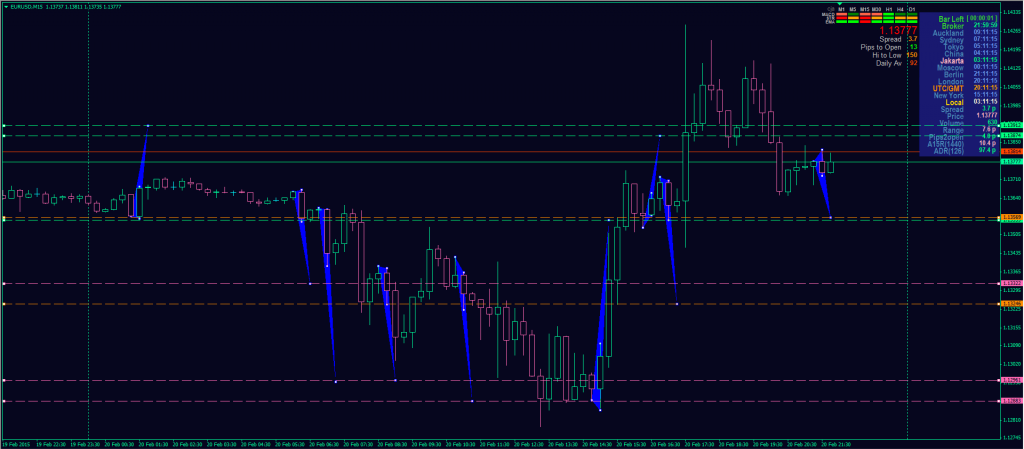
…. What is the indicator at the bottom of the image ? Do you use it as entry signal, if the histogram cross the zero line ? Thanks
Hi Brother, this is Force MA histo, comparing bull force ( High – Open) + (Close – Low) and bear force (Low – Open) + (Close – High).. Hope it help and best regards MTH
Hi Brother,
Your calculation formula is not ( Close – Open ) based on twoblink OCC. ( Bull = Positive ) , ( Bear = Negative ) as in OpenCloseCrossover calculation.
Is your formula more accurate???
Dear Kiads, Is it possible for us to reach the same trading success with the tools we already have? Best regards.
Hi Brother, 100% definitely big Yes… If you ‘see’ my shared videos about geometrical charting, I don’t use any Indicators there… just ‘angle lines’.. or I could trade in correct direction only with comparing 2 candles, So, all you need is ‘understand’ your tools in relation with how the market work. Even with only solid Money Management and closing eye, you could grow your account.. lol.., How do you think 50 years ago financial traders could make their consistent profit ? Wish You all the best MTH
And do u mind disclosing how the financial traders could make their consistent profit 50 years ago???
I have been thinking about this for some time, I think they are using Open Prices of Today or Close Prices of Previous Day. Meaning using Open prices to determine prices are getting higher or lower compared to previous days. Pls enlighten me, thx.
I only know I know nothing
Skype: learnalways@outlook.comFebruary 21, 2015 at 9:15 pm #4961Hi Brother, 100% definitely big Yes… If you ‘see’ my shared videos about geometrical charting, I don’t use any Indicators there… just ‘angle lines’.. or I could trade in correct direction only with comparing 2 candles, So, all you need is ‘understand’ your tools in relation with how the market work. Even with only solid Money Management and closing eye, you could grow your account.. lol.., How do you think 50 years ago financial traders could make their consistent profit ? Wish You all the best MTH
Hi brother, It is interesting if we can know the Correct Direction only comparing 2 candles …. Just using HLOC of the candles ? The candles must be stay near each other (as neighbor), or it is like SubSequence, comparing specified candles ?
Lol.. this is just old dog trick, just candle body engulfing, and this is part of my Geometrical Charting that never going public before.. (still don’t have time to create new video), this is great for higher TF but for this example I just use EURUSD M15.
PS. Brother GG53 please forgive me if I answer off topic questions here.. and please inform me if you like to remove my post here..

Lol.. actually I don’t want to share too many branch of charting analysis that maybe just make all of you more confuse…
Have a nice weekend All…
MTH
Intuition, Experiences and Common sense..
http://www.binaryoptionsedge.com/February 22, 2015 at 4:59 am #4967Lol.. actually I don’t want to share too many branch of charting analysis that maybe just make all of you more confuse… Have a nice weekend All… MTH
Understood & thanks brother, sorry i am asking too much ….
 February 22, 2015 at 10:07 am #4977
that the key money management only?kiad I love your ohlc based ma very much
February 28, 2015 at 10:06 am #5123There is one more thing that you “missed” in “fair” or “true” price:
In an UpTrend: Price = “true” price + Premium
In a DownTrend: Price = “true” price – Discount
G.
February 28, 2015 at 10:11 am #5124this system is a loser, sometimes it wins sometimes it loses ( big or small ) but at the end it loses, go try it. I don’t know why the thread starter is wasting your time like that. Seems to be an habit of his judging by his last failed threads at FF.

I didn’t present any system.
Please point me in the direction of my “failed threads at FF”…
If you are refering to the “…Pissing Dog” thread @FF – we just found one…
G.
-
This reply was modified 11 years, 6 months ago by gg53.
March 10, 2015 at 3:39 am #5612There is one more thing that you “missed” in “fair” or “true” price: In an UpTrend: Price = “true” price + Premium In a DownTrend: Price = “true” price – Discount G.
Anyone have any ideas on this? Sorry, but seriously who knows what “Premium” and “Discount” means to you GG. That is so vague. So frustrating.
I’m using Typical price for “fair”/”true” price. Cause I don’t have enough information to determine what this could be other wise.
My only wild guess is that maybe “premium” and “discount” is referring to the spread/bid/ask? I have no idea.
Just gotta vent a little cause I’ve/we’ve WASTED SO MUCH TIME on these vague or confusing concepts. I find them very interesting but it’s so annoying to try to guess exactly what you are talking about with the vague and confusing terminology. We can’t come to any accurate logical conclusions with such little information. I want to move on and put this BS behind me but my desire to learn is greater.
So please, please(!), give us a little more detail than these teasing tid bits! I don’t think you realize how frustrating it is.
March 10, 2015 at 4:17 am #5617“Fair” price manifest itself in turning points – because there is no more “fuel” to continue the rally or decline.
“Premium” is the difference between current price and “true” or “fair” price in an up trend, because of the rally and momentum. “Fair” price is always a bit lower in an uptrend, and the opposite in down trend.
Actual Price itself have a lot of “noise”, “fair” price is just below that noise in an uptrend.
The turning point, when the two “prices” meet – is the actual price minus the noise.
From here you got 4 options:
1. Measure the “noise” and deduct it from actual price.
2. If you consider a turning point (not the highest high) which price actually returns and meet “fair” price and “connect the dots” with a straight line – you’ll will get rough estimation of “true” price. If you can do better than that, and “connect the dots” with a automatic, better function, – you’ll get your “fair” price.
3. Use a linear regression of prices. Apply a std. least squares regression. Then create the regression line as price = a + bx, where a is the y-intercept and b the slope. To find the base price, calculate the residuals, then find the minimum residual value. Subtract that minimum value from the regression line to get the base, or “fair” price line.
4. Use a linear regression of volatility. Instead of price, using some measure of volatility related to the actual price level will give you a more direct view of the price-volatility relationship.
G.
March 10, 2015 at 5:48 am #5619There is one more thing that you “missed” in “fair” or “true” price: In an UpTrend: Price = “true” price + Premium In a DownTrend: Price = “true” price – Discount G.
Anyone have any ideas on this? Sorry, but seriously who knows what “Premium” and “Discount” means to you GG. That is so vague. So frustrating. I’m using Typical price for “fair”/”true” price. Cause I don’t have enough information to determine what this could be other wise. My only wild guess is that maybe “premium” and “discount” is referring to the spread/bid/ask? I have no idea. Just gotta vent a little cause I’ve/we’ve WASTED SO MUCH TIME on these vague or confusing concepts. I find them very interesting but it’s so annoying to try to guess exactly what you are talking about with the vague and confusing terminology. We can’t come to any accurate logical conclusions with such little information. I want to move on and put this BS behind me but my desire to learn is greater. So please, please(!), give us a little more detail than these teasing tid bits! I don’t think you realize how frustrating it is.
Brother, beside the more technical explanation from GG53 at the above post, you could also ‘enrich’ your knowledge base by reading from this analyst forum link here :
http://www.analystforum.com/forums/cfa-forums/cfa-level-iii-forum/91310292
and / or trom this investopedia link here (as general knowledge) :
http://www.investopedia.com/exam-guide/cfa-level-1/global-economic-analysis/forward-market.asp
So, you could follow the discussion with ‘non plain English’ terms like this one.. and please forgive me if I wrong, because I’m noob as usual..
MTH
Intuition, Experiences and Common sense..
http://www.binaryoptionsedge.com/March 21, 2015 at 8:05 am #5871There is one more thing that you “missed” in “fair” or “true” price: In an UpTrend: Price = “true” price + Premium In a DownTrend: Price = “true” price – Discount G.
Anyone have any ideas on this? Sorry, but seriously who knows what “Premium” and “Discount” means to you GG. That is so vague. So frustrating. I’m using Typical price for “fair”/”true” price. Cause I don’t have enough information to determine what this could be other wise. My only wild guess is that maybe “premium” and “discount” is referring to the spread/bid/ask? I have no idea. Just gotta vent a little cause I’ve/we’ve WASTED SO MUCH TIME on these vague or confusing concepts. I find them very interesting but it’s so annoying to try to guess exactly what you are talking about with the vague and confusing terminology. We can’t come to any accurate logical conclusions with such little information. I want to move on and put this BS behind me but my desire to learn is greater. So please, please(!), give us a little more detail than these teasing tid bits! I don’t think you realize how frustrating it is.
Maybe this example will steer you in the right direction:
Many standard indicators (oscillator types) will show you DIVERGENCE from actual price-action.
Those divergence are very powerfull trading signals, and almost immediatly price-action will follow (or “correct” itself) to the direction of the indicator.
So there is “something” that the indicator “knows”, and it “knows” it in advance, before the price action.
Can you use the above indicator “knowledge” not only in divergence situations?
Maybe you can follow the indicator “alternate price-action” to view undelying “true” or “fair” price?
G.
March 25, 2015 at 2:08 pm #5933Your Gadi_Currencies v3.0 Diff is working well as a divergence indicator.
March 26, 2015 at 10:38 am #5962Your Gadi_Currencies v3.0 Diff is working well as a divergence indicator.
Yes, but it’s an old one… I have an improved ones since than.
But we are in a “fair” or “true” price vs. current graph price discussion.
G.
March 26, 2015 at 11:58 am #5971“Open” and “Close” are terms borrowed from the Stock & Commodities markets, where there is a true “Open” of the day and true “Close” of the trading day.
In Forex there is no such thing, prices are in continues flow. Semi-true “Open” & “Close” only happen in Friday close and monday open – excluding interbank quotes during that time.
Since “Open/Close” are just snapshot at pre-defined time intervals – they are not true representation of inter-bar or inter-candle price action within that bar.
Price can move from much lower or much higher position in that bar to the “Close”, an unseen movement which should affect you trading and entry decision.
G.
April 24, 2015 at 10:56 am #6404Your Gadi_Currencies v3.0 Diff is working well as a divergence indicator.
Yes, but it’s an old one… I have an improved ones since than. But we are in a “fair” or “true” price vs. current graph price discussion. G.
Hi gg53, i’am really happy to see you active again!
I really like this indicator and because i see that you have a new version i want to ask you : is it possible to get this new one? maybe a version were the Diff-value is the first buffer?
Thank you in advance and greetings
robcole
June 2, 2017 at 9:12 am #13958Just read about the old stuff and I found a logical problem: Prize can deviate from its value. Wouldn’t it mean that the true value can be far above/below a candle? And what if we see another contradiction of both measures (OHLC4 and C) in such a region where prize already is way off its true value. These cases may lead to big DD.
In other words that would mean that true prize can be represented in two, three or many candles. And again, we have the old problem of averaging (which period is at which time the optimal one) …
@gg53: I’d be happy to hear your opinion on that points. -
This reply was modified 11 years, 6 months ago by
- AuthorPosts








- You must be logged in to reply to this topic.